
INTERNATIONAL EXPERIENCE CANADA 2026: LAST CHANCE TO ENTER THE POOL BEFORE OCTOBER 19

SIX PROVINCES, NEW INVITATIONS: WHO IS BEING SELECTED IN PROVINCIAL NOMINEE DRAWS
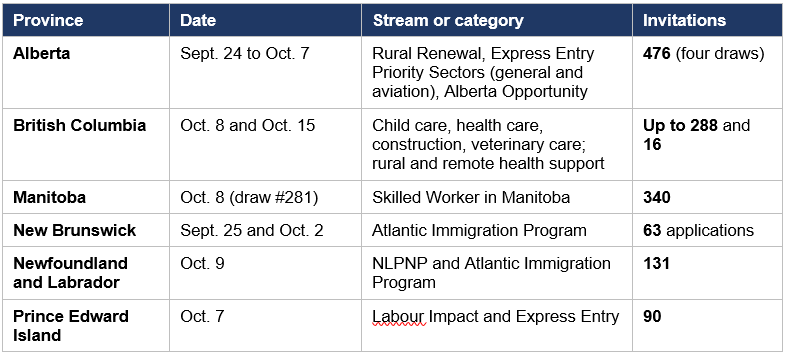
Six provinces published new selection results in the past two weeks, and together they show where regional employers are looking for workers right now: health care, child care, construction, aviation and general skilled labour. If a provincial nomination is part of your plan, here is what each province did and what to take from it.
The results at a glance
Alberta: 476 invitations in four draws
The Alberta Advantage Immigration Program (AAIP) released the results of four draws between September 24 and October 7:
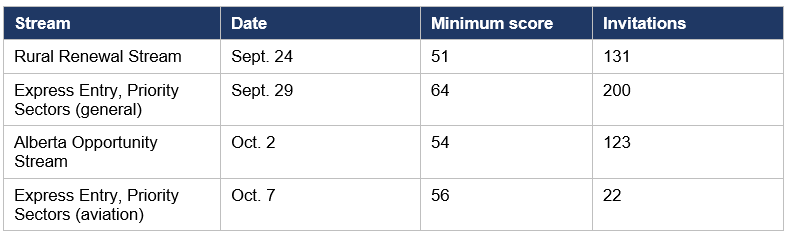
The aviation draw is a good example of how Alberta targets specific industries, and the Rural Renewal draw shows continued interest in bringing workers to smaller communities. Reports on the October 7 update indicate that Alberta had issued 5,541 nominations against a 2026 allocation of 6,603, which leaves about 1,062 spaces for the rest of the year. Spaces are limited, so timing matters.
British Columbia: up to 288 invitations in four categories, plus a rural health round
On October 8, the BC Provincial Nominee Program (BCPNP) invited candidates in four priority occupation groups:
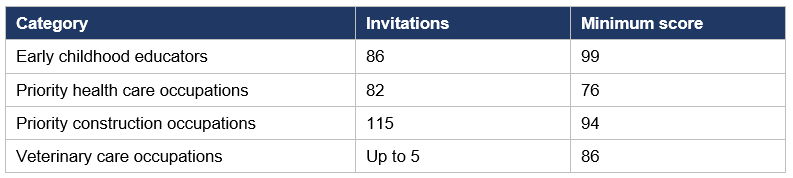
The veterinary draw was open to all priority veterinary care occupations, but animal health technologists and veterinary technicians (NOC 32104) had to hold a valid professional designation. Of note, the health care and child care cut-offs have come down over the year, while construction was the only category where invitations grew compared with the September round, according to published comparisons.
On October 15, the BCPNP also held its third round under the Temporary Rural/Remote Health Support Initiative, issuing 16 invitations with a minimum score of 54. This time-limited pathway is meant to retain up to 250 workers who already work for a BC health authority in cleaning or security roles in rural or remote communities. Earlier rounds invited 60 candidates in July and 33 in September, according to published summaries. Registration for the initiative closed on October 7, so it is open only to those who already registered.
Manitoba: 340 invitations in draw #281
Manitoba held draw #281 on October 8 under its Skilled Worker in Manitoba stream and issued 340 invitations. The round included occupation-specific selections for education and child care occupations and for health occupations, along with the Skilled Worker pathway. Manitoba has now issued about 7,223 invitations in 2026 across its draws. Manitoba's system rewards candidates with a real connection to the province, so work experience, family ties and prior study there can matter greatly.
Atlantic Canada: New Brunswick, Newfoundland and Labrador, and Prince Edward Island
New Brunswick selected 63 applications under the Atlantic Immigration Program (AIP) in draws held September 25 and October 2, for candidates registered before the cut-off dates of September 24 and October 1, 2026. The categories were construction, manufacturing, professional and IT, sales and services, transportation, other trades, and education, social and community services. The province notes that AIP figures represent applications selected for processing.
Newfoundland and Labrador held its 17th round of selection on October 9 through its Enhanced Expression of Interest system and issued 131 invitations: 130 under the Newfoundland and Labrador Provincial Nominee Program (NLPNP) and one under the AIP. That is more than triple the 41 invitations issued on September 25, and it brings the province to 2,826 invitations in 2026. The AIP also returned after the previous round went only to NLPNP candidates.
Prince Edward Island issued 90 invitations on October 7 to workers in priority sectors, in a smaller round than September's 195. The province continues to prioritize candidates with job offers from PEI employers and international graduates of UPEI, Holland College and Collège de l'Île. PEI has invited 1,319 candidates in 2026, and the next draw is scheduled for October 15.
What the AIP requires: a valid job offer from a designated employer in an Atlantic province, qualifying work experience (recent Atlantic graduates may be exempt), suitable education, approved language test results, proof of settlement funds unless you already live and work in Canada with a valid permit, and a settlement plan from a service provider organization.
What these results mean for you
• Targeted draws reward specific profiles. Child care, health care, construction, aviation and trades appear again and again. Match your occupation carefully, not just your job title.
• Scores vary widely between provinces. A score of 76 can be enough in one category while 99 is needed in another. A province or stream with a lower threshold may suit you better.
• A job offer or local connection helps. Many programs weigh employer ties, prior study or work in the province.
• Allocations are limited. With only a few months left in 2026, provinces may adjust how they use their remaining spaces.
• Keep documents ready. Language results, credentials and work letters need to be valid at the time of invitation.
A provincial nomination is only part of the process. After nomination, you still need to apply to Immigration, Refugees and Citizenship Canada (IRCC) for permanent residence, and every stage has its own requirements and timelines.
Which province gives you the strongest path to permanent residence?
The right program depends on your occupation, language results, work history and family situation. Global Opportunities will compare the provincial and federal options available to you, explain the risks, costs and realistic timelines, and help you build the strongest application. Contact us today to book an assessment with Global Opportunities and find out which path fits your situation.
Sources: Government of New Brunswick, Atlantic Immigration Program selection rounds; IRCC, Atlantic Immigration Program eligibility. Alberta, British Columbia, Manitoba, Newfoundland and Labrador, and Prince Edward Island draw details as published by provincial programs and reported by immigration.ca (secondary source); figures should be confirmed on each provincial website. Draw results, allocations and criteria may change. This article is for general information only and is not legal advice.